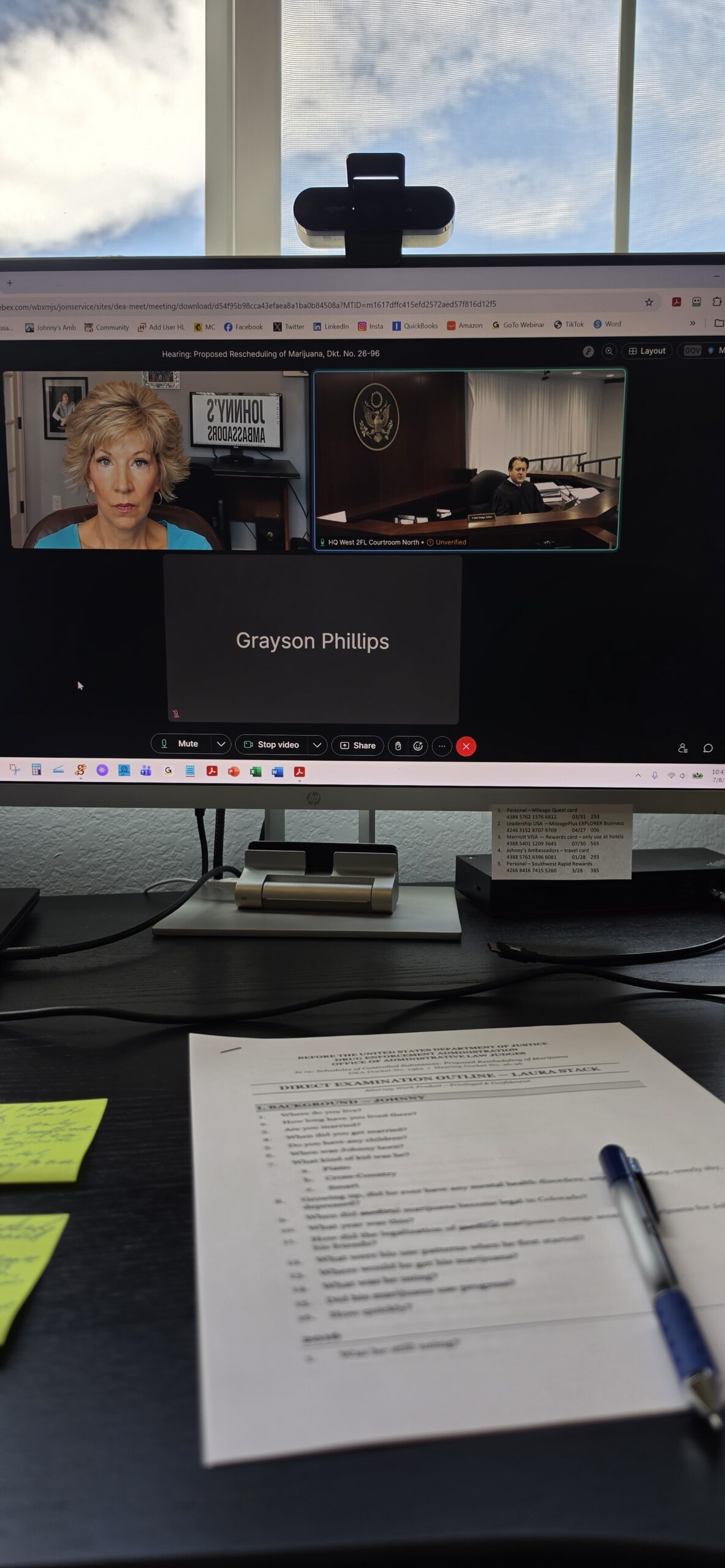
On Wednesday 7/8, I was a witness in front of Chief Administrative Law Judge Derek C. Julius, who presided over the Drug Enforcement Administration’s marijuana rescheduling hearing. The purpose of the hearing was to evaluate evidence regarding the proposal to move marijuana from Schedule I to Schedule III of the Controlled Substances Act. I consider my testimony a success in supporting NOT doing this! I testified for about an hour and 15 minutes and submitted 85 parent affidavits as evidence (gathered by Crissy Groenewegen of Parent Action Network). I was worried I might forget some of the detail from Johnny’s story 12+ years ago but remembered everything and was able to answer all the questions. At the end, I braced myself for the cross-examination from the four DEA attorneys, but they told the judge they had no questions regarding my testimony. The attorney for our side asked me about details I often try hard to forget, so it was difficult, but I’m glad I did it. Next, the parties will submit post-hearing brief and closing arguments, and the judge will review the record and issue his formal recommendation to the DEA Administrator, Terry Cole. I can’t say my testimony will change the outcome, as it appears the system has been changed to push this through (I anticipate there will be additional appeals). But at least it’s part of the U.S. Department of Justic legal record, and we’ve been heard. The government can’t say they didn’t hear from anyone on our side! I’m honored to have the opportunity to speak to the millions of parents whose children have been harmed by THC products. Thank you for your constant support and encouragement!
Laura’s Closing Impact Statement
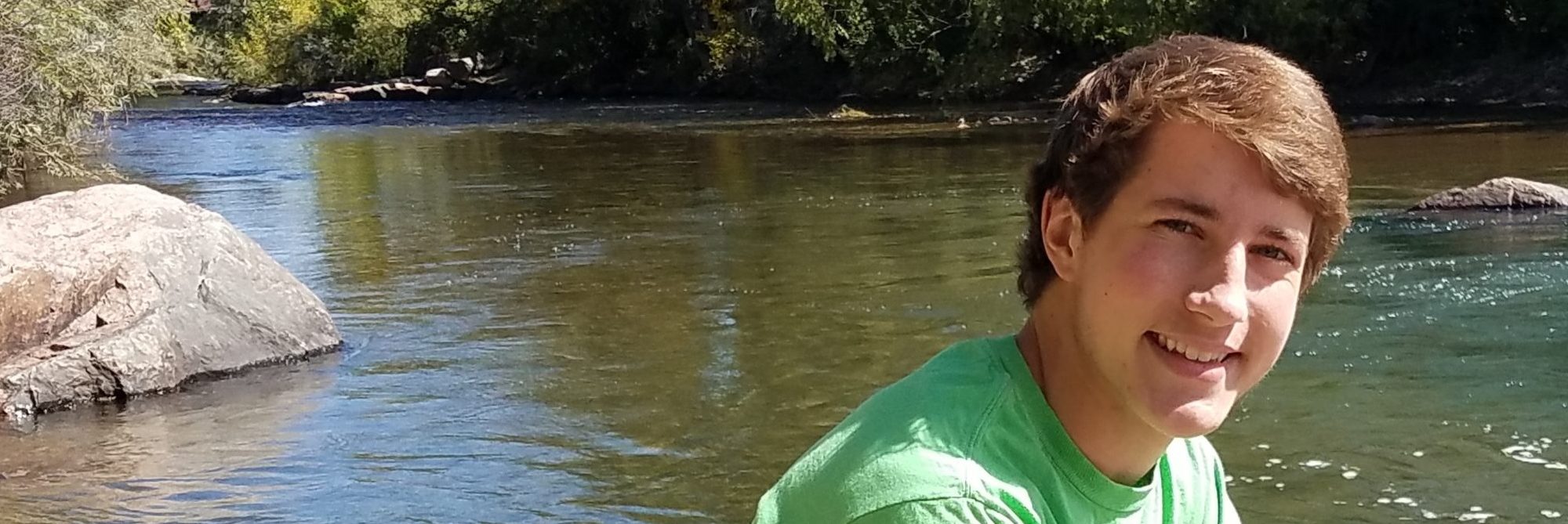
Johnny would be 26 years old if he were still alive today. I often wonder what he would look like. Where would he be working? Would he be married? Would I have any grandchildren? I will never know the answer to any of those questions, but one thing I know for sure is he would still be here today had he never used marijuana.
My son was loving, intelligent, and talented, with no history of mental illness, no family history, and no genetic risk. My son’s psychotic break would not have happened without exposure to the high-potency marijuana, dabs, and vapes he was given by friends and then bought with his “medical” card. Hundreds of thousands of teens and their families have been harmed by marijuana. Nearly 2.7 million teens age 12 to 17 self-reported using marijuana in 2024, and over 45% have problematic use – Cannabis Use Disorder—according to our own Substance Abuse and Mental Health Services Administration (SAMHSA).
Marijuana is never guaranteed to be safe for anyone, at any age, but it’s especially damaging for people under the age of 30 whose brains are still developing. It is not benign. It is not harmless. It is not medical. Today’s potent pot and THC products are incredibly addicting, leading to IQ loss, loss of motivation, higher school dropout rates, physical problems such as CHS, stroke, and cardiovascular issues, and the onset of mental illnesses such as Cannabis-Induced Psychosis, bipolar, anxiety, and depression. Many convert to serious mental illnesses like schizophrenia, chronic conditions requiring social security payments for life at the taxpayer’s expense. Or worse, they die, through suicide, violence, or car crashes.
My son Johnny is now a statistic. According to the Colorado Violent Death reporting system, for youth ages 15-18 in Colorado, suicide is now the #1 cause of death, and marijuana is the #1 substance found in their toxicology reports, twice that of the #2 substance, alcohol.
How many deaths will it take? How many “near deaths” and mental health crises are necessary to get people’s attention? I have personally seen hundreds of medical interventions, many hundreds of thousands of dollars spent on treatment for each child, and the tragic impact on families, communities, and our children’s personalities and potential.
And yet, the marijuana industry says it’s “Just weed” and can’t hurt them. THC is the number one reason our schools have alternate education and vape detectors in the bathroom. Students are vaping high potency THC right in the classrooms. Marijuana is the number one illicit substance for which teens are treated in the United States. While alcohol is the most frequently abused substance overall, cannabis remains the primary driver of adolescent substance use disorder (SUD) treatment admissions by a wide margin. Hundreds of thousands of high school seniors are the local drug dealers, like my son was, selling legal weed they got with a legal “medical” card bought in a legal dispensary at 18 years old.
More THC will not mean more benefit – it will mean more harm. I’m terrified that no one in the federal government understands or cares. The DEA just scheduled 7-OH into Schedule 1 because it “targets highly concentrated, synthetic 7-OH products, which pose a growing threat to public safety and health.” Today’s high potency, genetically modified marijuana and nearly pure concentrated THC products are no different and affect millions more people. We can’t continue to erode the perception of harm in the minds of millions of teens and lose generations of young people to addiction and mental illness.
Some days, I feel hopeless, giving hundreds of student assemblies every year and feeling like I’m barely making an impact. I feel crushed hearing countless stories every day from parents wondering what their son’s baseline will be when he leaves the hospital again or residential treatment again. I feel brokenhearted talking about the death of my son every day and hoping his life saves someone.
Johnny was a wonderful person. He wasn’t perfect and he made some bad decisions, but he did not deserve to become psychotic from a drug he was told was perfectly safe. Johnny was a victim of the marijuana addiction-for-profit industry. He should never have had access to it in the first place. The marijuana industry is preying on all our children, destroying their minds and their futures. Millions of teens across the U.S. are being addicted to and damaged by this substance, thinking they are being cool or just partying. Johnny never thought it would happen to him, either.
Why do teens believe it’s harmless? Because of the misinformation campaign successfully waged by the marijuana industry, convincing them it’s healthy. All teens know a doctor would never prescribe alcohol for stress. All teens know nicotine is addictive. All teens know “one pill can kill.” But teens don’t know marijuana can make you psychotic at 19 years old for the rest of your life. They have no idea about the impact of THC on their brain development. We are losing an entire generation of young people because we have normalized, commercialized, and glorified this addictive and harmful substance, as proven by thousands of research studies.
Please protect our youth and keep them from following Johnny’s path. Thank you.
Thank you Laura for your powerful statement. You are so clear and articulate and authentic in this fight. You care so deeply and it comes from the very real suffering that you know.
What an inspiration to us struggling to be more in the fight and bring more attention to this nightmare for our youth and families.
Good job!! Thank you for what you do!!
Thank you for your courage and leadership, Laura. You are simply the strongest advocate in this space. You’ve transformed your pain into purpose, and your work inspires so many. As someone who works with youth alcohol and other drug prevention, I am incredibly grateful to have you as one of our Prevention Champions. Thank you for all you do!
Thank you for your unwavering advocacy. You are a true hero, born from the fire of the tragic loss of your son. Please know you are having a huge impact and helping us parents (and pediatricians) with education, content, statistics, and encouragement to carry this message forward.
Jill (parent and pediatrician)
Bravo for your amazing testimony. And yes we Are losing an entire generation of kids due to this industry and their misinformation. You are a true champion of this cause and you are gifted in conveying this important evidence.
Thank you, Laura, for taking this important message to Washington and for sharing your family’s story as many times as it takes. You have a gift for conveying the science and the public health impact in a way that few others can do. Your courage and hope are inspiring and definitely make a positive impact. Keep up the great work and Godspeed!
Thank you for standing up for all of us who are affected by this. It is heartbreaking.
This is so powerful. Thank you for being a brave advocate for all of our kids. You model bravery for us all and help us all see the power of using your voice for change. We are grateful.